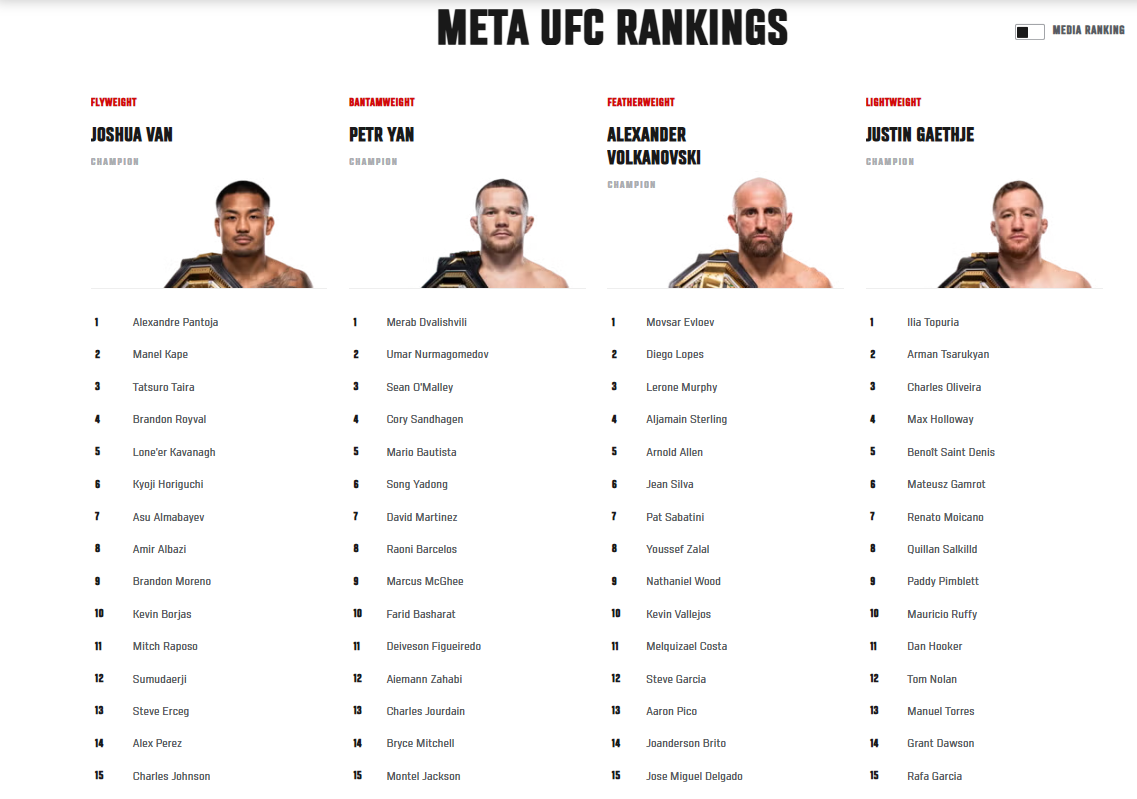
The UFC has taken a step that could forever change the way mixed martial arts is analyzed. The organization has begun implementing the so-called Meta Rankings, a new system based on artificial intelligence that aims to offer a more accurate view of the real performance of fighters beyond traditional rankings.
For years, the official rankings have been the subject of debate among fans, analysts and fighters. Criticism has been constant. Some fighters appeared too high despite accumulating recent losses. Others seemed to be stagnant despite stringing together important victories. The general perception was that the traditional system did not always accurately reflect the competitive reality of each division.
The new Meta Rankings were born precisely with the intention of providing an additional layer of analysis.
Unlike classic rankings, which depend on human votes made by a group of specialized journalists, the Meta system uses artificial intelligence models capable of processing enormous amounts of information related to each fight.
The aim is not to replace official rankings, but to complement them with a ranking that takes into account variables that are normally difficult to assess manually.
Among the factors analyzed by these systems are the quality of the defeated opponents, the way in which the victories occurred, recent activity, the competitive context of each division, current streaks, round-to-round performance and even certain statistical patterns extracted from thousands of historical fights.
Artificial intelligence doesn't just count wins and losses. It tries to measure the real strength of each fighter at a specific time.
For example, two fighters may come in with the exact same recent record. However, if one has defeated higher-ranked opponents or shown superior dominance during their matches, the system may consider their competitive position to be stronger.
The arrival of this model is especially interesting in a discipline where traditional mathematics rarely works.
The lightweight division itself offers a perfect example. Ilia Topuria defeated Charles Oliveira and also managed to beat Max Holloway. Holloway had previously knocked out Justin Gaethje. Oliveira had also defeated the American. On paper it seemed logical to think that Topuria would have a clear advantage over Gaethje.
However, when the two faced off in the UFC Freedom 250, the result was completely different.
Those kinds of situations are precisely what the artificial intelligence tries to contextualize. Instead of assuming that a victory over an opponent automatically implies superiority over all fighters related to him, the models analyze styles, combat patterns, recent performance, and multiple additional variables.
According to those responsible for the project, one of the main objectives is to reduce some of the biases that have historically affected sports rankings. The popularity, media noise or impact of certain names can influence public perception. Artificial intelligence, at least in theory, analyzes only the available data.
That doesn't mean the system is perfect.
In fact, some fans have already shown their doubts. MMA is still an extremely complex sport and there are factors that are impossible to fully quantify. The ability to adapt during a fight, the psychological aspect, hidden injuries or simply a bad night can alter any prediction.
That is why many experts believe that the true value of Meta Rankings is not in replacing human opinion, but in complementing it.
The combination of advanced statistical analysis and traditional assessment could provide a much more complete picture of each division.
In addition, the tool allows you to detect trends that often go unnoticed. Fighters who do not yet occupy prominent positions in the official rankings may appear much better valued by artificial intelligence due to the quality of their recent performances. Similarly, some historical names may begin to lose positions before that fall is evident to the general public.
The light weight again serves as a perfect example.
After Justin Gaethje's win over Topuria, the division is wide open. Arman Tsarukyan is still waiting for a shot at the belt. Charles Oliveira is looking to stay in the conversation. Paddy Pimblett continues to climb the ranks thanks to his growing popularity. And Topuria faces the challenge of rebuilding his way to the top.
Determining who is actually closest to the championship is precisely the kind of question that the Meta Rankings try to answer.
Artificial intelligence does not decide who fights for a belt or who officially occupies each position. That responsibility still belongs to the UFC and its usual processes. However, it does offer a new way of understanding the sport and a tool capable of analyzing divisions with a depth never seen before.
Perhaps in a few years it will be normal to consult a classification generated by algorithms before each major event. What seems clear is that MMA have fully entered the era of artificial intelligence. And the new Meta Rankings are one of the most obvious signs of this change.